


This post is based on an original article by Rizwan Virk, available with references in the above pdf.
The entry video is meant to introduce my readers to Rizwan Virk (from whom I’ve taken several online simulation/religious courses and I would recommend them to my readers).
I also introduced Riz to Jason “archaix” Breshears, which eventually led to the below interview.
Now, for Rizwan Virk’s essay below:
The simulation hypothesis as a new technoscientific religious narrative
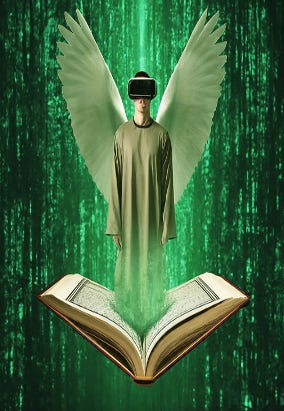
Rizwan Virk
College of Global Futures and Fulton Schools of Engineering,
Center for Science and the Imagination, Arizona State University
Email: rvirk1@asu.edu (until Dec, 2025), riz@alum.mit.edu (permanent)
Abstract: In the age of social media and AI, a new technoscientific socially constructed narrative about the future and our physical universe emerged which is both redefining traditional religions but also becoming a ‘religion for atheists’: the simulation hypothesis. This paper looks at parallels between metaphors used in traditional religious narratives and the simulation hypothesis, via scriptural analysis and comparative review. In addition to reviewing the literature on simulation theology, this paper draws from four common spiritual concepts, distilled from scriptural references, and shows parallels across different religious traditions and maps them to specific aspects of the modern simulation hypothesis. This includes the nature of the physical world as an illusion, the process of incarnation, the recording angels and Scroll of Deeds, and the creation of the physical world. This analysis illuminates how technoscientific metaphors have been wielded in the creation of new religious narratives and how that process continues today.
Keywords: Simulation hypothesis; AI and theology; Genesis; Scroll of Deeds; angels; afterlife and AI; video games and religion
(1) Introduction
In recent times, with the rise of video games, particularly massively multiplayer online roleplaying games (MMORPG), virtual reality (VR) and artificial intelligence (AI), a new technoscientific narrative and metaphysical idea has become popular, referred to colloquially as the simulation hypothesis. The simulation hypothesis is broadly defined as the idea that the physical world that we live in is not the real world, but rather is a virtual world contained within a larger reality, a computer simulation or a video game world. Although the metaphysical nature of the simulation hypothesis has its roots in philosophy, hearkening back to the skeptical arguments of Berkeley and Descartes, the modern version has arisen through the more recent medium of science fiction.
The most popular depiction of this concept, in visual form, was in the final year of the twentieth century in the film, The Matrix (1999), when the Internet was relatively new, and personal computers and video games were much less powerful than they are today. In “The Matrix”, the protagonist, Neo (Keanu Reeves) assumed that he was living a real life in a real world, complete with a job at a computer company, only to find out that his world was not real: instead, it was a virtual simulated world, while his physical self actually existed outside of the simulation.

This idea that the physical world that we perceive through our senses is not the real world is one of several core aspects of simulation theory (a term often used to describe the broad field of discussions around the simulation hypothesis), which parallel core ideas and specific theological and cosmological precepts in many religious scriptures and commentaries. While simulation theory advocates often use the terminology common in video games (MMROPGs in particular), computer programs and AI, in the religious texts and commentaries these ideas are often expressed in metaphors that could be understood by the laity of the time. It is implied that these metaphors, used to describe the nature of ultimate reality, may contain latent meanings. The same is true of modern simulation theory. In this paper, I explore some of these parallels in the context of technoscientific narratives in both modern and ancient times, drawing on simulation theory and concepts from scriptures in Islam, Hinduism, Christianity, Judaism and Buddhism.
Beyond the textual parallels to the simulation hypothesis, a central argument of this paper is that sages and mystics, attempting to codify their insights related to the ultimate nature of reality, will use commonly understood metaphors, often based on the science and technology of the day. This process is continuing with current technologies (video games, AI, virtual reality) in the present day as new, updated technoscientific metaphors take hold. This is not purely an interpretive or a sociological argument or even a hermeneutical argument, but this line of thinking suggests the authors of scriptures may have been, at least in the examples given here, attempting to describe (somewhat imperfectly) some underlying aspects of ultimate reality through these metaphors. The usage of similar metaphors not only across different sects of the same religion, but across religious families strongly suggests that they may have been describing similar underlying aspects of ultimate reality, but did so within their specific cultural context.
One implication of this work in drawing parallels of verses from different religious families and sects is that there are common spiritual concepts among the specific religions quoted. These ‘spiritual concepts’ have often been expressed symbolically as metaphors, a practice that is common in religious texts (Ferré, 1968, p. 327). These metaphors need to be understood by the laity of the day and may be trying to express an idea that is divine or outside the physical realm. Ferré continues an argument that goes back to Thomas Aquinas and beyond, that theological literalism may not be the best way to read religious texts. Swinburne (2007, p. 99) argues that metaphors and analogies are used in revelation to make them understandable across cultures, but also so that the religious message behind the metaphor (usually one about how to live life) might be understood even if certain scientific facts or presuppositions are found to be false by later generations.
Metaphors that draw on technology or the latest scientific knowledge can be called technoscientific metaphors. Even a cursory examination of various scriptures reveal the liberal use of technological objects such as books, wheels, clothes, trumpets, gates, etc., in defining phenomena that purportedly exist both inside and outside of the physical world. In Buddhism, for example, the metaphor of the wheel is used to express the idea of transmigration of souls (bhavachakra) through Samsara and is not meant to be taken as a literal wheel but as a ‘symbolic representation of Samsara’ (Tamang, 2020, p. 80). In the Dhammapada, the Buddha uses the example of how ‘Suffering follows an evil thought as the wheels of a cart follow the oxen that draw it’ (Easwaran, 2009, p. 104). In the Qur’an, the metaphor of a ‘scroll’ or ‘books’ is used and will be expanded on in this chapter. In Sufi traditions, we see mirrors such as the ‘mirror of nothingness’ (Nasr, 2008, p. 43), and the veils that separate humans from God (Nasr, 2008, pp. 48–49). Even the whole natural world (defined as anything other than God) is compared to a book or parchment by Ibn’ Arabi (Rašić, 2021, p. 2). A central argument of this paper is that taking these technological objects as technoscientific metaphors, we can compare them to the modern simulation hypothesis by treating it as a modern technoscientific metaphor as well.
A second possible, much broader implication of this work is that because mystics, in some cases from vastly different religions (Islam and Hinduism, for example), used similar metaphors to describe similar spiritual concepts, that these mystics may have been trying to allude to a common ontological reality beneath their scriptural assertions and language. Ferré (1968, p. 333) goes on to argue that science itself also uses metaphors, which are called scientific models in an attempt to understand an underlying reality. While we cannot be certain that any particular religious revelation actually results from perceiving ultimate reality, we can assume either a sociological view or an ontological view. In the sociological view, these metaphors have just been carried from one region to the next, and are not describing anything that could be considered real. In the ontological view, we could assume that they may be seeing a common aspect of underlying reality. While it will not be possible to address this broader implication or argument in this article, the comparative analysis of metaphors with each other, and then linking them to modern technological metaphors (i.e. the simulation hypothesis) could be a first step to showing a technoscientific infrastructure or mechanism to the revelations and mystical visions of ancient sages and saints.
(2) Background on the simulation hypothesis: NPC vs. RPG variants
The idea that we live inside a computer simulation has been present in science fiction in the modern era of computers, both before and after The Matrix. In fact, another film released in the same year as that blockbuster also explored the simulation theme, The Thirteenth Floor (1999), which was adapted from a German TV series, World on a Wire (1973), which in turn was adapted from an earlier novel, Simulacron-3 (Galouye and Resnick, 2021/1963). In 1977, well known sci-fi writer Philip K. Dick, whose work reportedly inspired the Wachowskis to create The Matrix, gets credit for being among the first to suggest the idea as a serious possibility, with a line from his speech at a sci-fi conference in Metz, France: ‘We are living in a computer-programmed reality and the only clue we have to it is when some variable is changed, some alteration occurs in our reality’ (Philip K. Dick speech in Metz, France, 1977, 2019).
In the twenty-first century, science fiction live action and animated series such as Black Mirror (2011), Futurama (1999) and Rick & Morty (2013) have explored the simulation theme specifically in multiple episodes, and continue to do so up to the present day (Siebold, 2023; Radulovic, 2025). The simulation theme in many of these works (and other works of science fiction) have paralleled theological discussions in many ways (Ford, 2000; Steinhart, 2010, p. 27; Sierotowicz, 2025), raising questions such as: is there a creator of this world? If so, who is the Creator? Is there free will? What is our purpose in being here?
While non-technological antecedents of the simulation hypothesis in philosophy can be traced to Descartes’ Meditations (Descartes, 1911) and Plato’s Cave (Eyer, 2009), modern technologists and philosophers have also tackled the question head on of whether we live in a computer simulation in recent years. Moravec suggested that we might be living inside a computational universe, and when the first two Matrix sequels (The Matrix Reloaded and The Matrix Revolutions) were released, a number of essays were commissioned by the Wachowskis about the topic. Several collections of essays exploring the philosophical implications of being inside a simulated virtual world were published by both Yeffeth (2003) and Grau (2005). One of the modern philosophers to explore the metaphysical idea of skepticism and of living in a virtual reality was David Chalmers, who coined what he termed the Matrix hypothesis in an essay, ‘The Matrix as Metaphysics’ (Chalmers, 2004). Chalmers again explored his idea that we could be inside a virtual reality (as players with virtual reality headsets on, like the characters of The Matrix, or as AI characters) further in a book-length work (Chalmers, 2022), which included references to theological implications.
The current terminology most often associated with being inside a virtual world, the simulation hypothesis, is attributed to Nick Bostrom’s simulation argument, which he described in his paper, Are we living in a computer simulation? (Bostrom, 2003a). In Bostrom’s argument, he lays out the possibility that a technological civilisation like ours could achieve a certain level of AI technology (which he refers to as a ‘posthuman civilization’) such that it will be able to simulate entire beings/minds. Bostrom’s argument rests on several assumptions, including substrate independence (i.e. minds can be run on silicon or biological materials), and estimates for computing requirements for memory and processing of individual minds, entire civilisations and their complete histories. Such posthuman civilizations, asserts Bostrom, may want to create simulations of their ancestors, which he calls ‘ancestor simulations’ (Bostrom, 2003a, p. 6), or ‘ancestor sims’ for short.
Bostrom’s argument rests on his trilemma, arguing that there are only three possibilities, whose probabilities must add up to one: 1) that no civilisation will ever reach the posthuman phase (and thus no ancestor sims simulations are possible), 2) that civilizations that reach the posthuman phase would not be interested in or would prohibit creation of ancestor simulations, or 3) that we are most likely inside a simulation. The argument asserted that if option #1 and option #2 are not true – i.e. that ancestor sims are both possible and desirable, then advanced civilisations would create a large number of ancestor sims with a large number of simulated minds, such that the number of simulated minds or worlds would be significantly larger than the number of minds in the non-simulated world (‘base reality’). Bostrom’s actual maths attempted to categorise the ratio of the number of simulated beings (i.e. AI beings) to biological beings inside option #3, the scenario in which many simulations are created. Elon Musk, speaking at the Code Conference in 2016, an annual event held for technology executives by Vox media, stated that the chances that we are in base reality is only one in billions (Griffin, 2016), using Bostrom’s logic. In this case, Musk was referring to the ratio of base reality (of which there is only one) to simulated realities or virtual worlds (of which there might be billions), rather than the ratio of biological to simulated beings/minds which Bostrom used. I have referred to this version as the simplified simulation argument (Virk, 2025b, pp. 136–137).
Technically, Bostrom referred only to the conclusion implied by the third leg of his trilemma as the simulation hypothesis (i.e. that we are most likely in a simulation) (Bostrom, 2003b). However, since then the terminology has taken on a broader meaning encompassing all ways of imagining that we might be inside a computer-programmed virtual reality (Chalmers, 2022, p. 29; Brian Bergstein, 2025). This includes the possibility of being AI simulated minds within a simulation, as well as being a character in a simulation whose player is in a virtual reality headset or other device, as was depicted in The Matrix. In my earlier book, The Simulation Hypothesis and related articles (Virk, 2019c, 2022), I have summarised two different flavours of simulation theory, the NPC (‘non-playable’ or ‘non-player’ characters) vs. RPG (‘role playing game’) versions, speculating further that these two are in fact the ends of an axis, the NPC vs. RPG axis.
NPC was a term which arose from table-top role-playing games such as Dungeons and Dragons (D&D) but has become adopted widely in the video game industry. These characters are controlled only by code and do not have a player outside the game controlling them - in the past NPCs have been relatively limited in their function (which are often called ‘dumb NPCs’), but smart NPCs are now beginning to emerge with virtual minds (powered by LLMs such as ChatGPT, Google Gemini, etc.), and realistic virtual bodies powered by AI, built on platforms like Epic’s Metahuman.
The RPG terminology (‘role-playing game’) also began with tabletop games such as D&D, where players exist outside of the simulation and have characters, called avatars, which they control or are otherwise attached to in the simulation. The term avatar itself comes from Sanskrit (‘to descend’, as in descending from divinity into bodily form, like an incarnation of Krishna) and shows a peculiar similarity to theological ideas of divine beings descending into a video game.
A recent variation of the idea that we may be AI beings inside a virtual or computer generated reality has arisen, called ‘Prompt Theory’, which went viral with the ability of users to create realistic videos using prompts (Iacono, 2025). In this variation of simulation theory, all of our lives are based on prompts, and created by AI to look as if the world and the beings inside it are real, but in fact, this is just a type of video or film created by AI that cannot be distinguished from a ‘real’ world. ‘Prompt Theory’ also begs the question of who the ‘prompter’ is and whether the ‘prompter’ has asked AI to create situations for beings that are unaware they are inside a video. The terminology arose in 2025 with a number of viral videos (initially created by Google Veo 3), featuring extremely realistic characters (inside extremely realistic landscapes), who are asking or speculating or in fact, denying that they were created from prompts.
While these videos are two-dimensional videos only, the landscapes they show can be quite realistic; in one case, prompting the AI-character to question whether so much beauty could have been created by a prompt (Prompt Theory, 2025; The Prompt Theory: 4 Minutes Straight of Google Veo Prompts, 2025). Thus, we can consider ‘Prompt Theory’ a subset or branch of simulation theory, as it questions whether we are just AI characters within a simulated/AI-generated landscape. An earlier example of this type of meta-reference of artificially created characters, questioning if they were inside a simulation, appeared in another viral video of a video game world. This was depicted in a demo called The Matrix Awakens(2021), which was originally created as a marketing companion to the fourth Matrix film, The Matrix Resurrections (2021). In this incarnation, the player’s avatar walked around the virtual landscape and asked the NPCs (in this case they were upgraded to be powered by an LLM to become SmartNPCs) whether they were in a simulation (Telling NPCs they Live in a Simulation - Unreal Engine 5 AI NPCs, 2023). The characters had a variety of human-seeming reactions, ranging from dismissal to disbelief to curiosity. In both of these cases, the ‘Prompt Theory’, and the examples of SmartNPCs, we see variations of the NPC version of the simulation hypothesis. Both of these examples also touch on some of the theological issues and parallels that we will be exploring in this paper.
(3) Related literature
AI in religion has been explored in various capacities, including how AI is being used within religious settings by priests to prepare sermons (Cheong and Liu, 2025), and by various parties (both startups and religious organisations) to create religious chatbots that users can query about aspects of the religion (Wright, 2024). Wright describes a number of chatbots that are meant to be trained on religious scriptures, including QuranGPT, Bible.ai, Gita GPT, Buddhabot, Apostle Paul AI, and Confucius (Wright, 2024). Because these chatbots are generally trained on a set of specific texts and domains, they are often based on SLMs (Small Language Models) rather than LLMs, which are models that use much fewer parameters (Caballar, 2024).
In other contexts, robots have been used that act as priests, such as Mindar, ‘a robot priest designed to resemble the Buddhist goddess of mercy’ (Yam and Jackson, 2023). Yet another way that AI has been used in the religious domain is to generate AI videos based on scriptural stories. Examples of these types of videos are proliferating on platforms such as TikTok, via accounts like Bible AI shorts (Christian Post, 2025). The proliferation not only of AI image generators, but newer generations of video creation tools (such as Google Veo, Kling, etc.) are able to generate realistic videos from prompts or from single images.
These different cases show that AI is already being trained to grasp religious concepts and is becoming a key part of future religious practice. However, they are only partially relevant to our exploration of the parallels of theological precepts and assertations with AI and the simulation hypothesis, in that they may portend future AI that does not realise it is in a simulation, or priests and/or prophets that are AI, all of which would fall under the NPC flavour of the simulation hypothesis.
AI has grown rapidly since the release of ChatGPT in November 2022 (Tamim, 2023), and one area that is relevant to the discussion of the simulation hypothesis and religion is the issue of evolving relationships between humans and AI chatbots that exhibit human personalities and traits. This includes chatbots from companies like Replika, character.ai, as well as others who have built chatbots on top of LLM platforms like ChatGPT. These chatbots take on a personality, and in some cases, they come complete with visual representations such as avatars, making them a class of Smart NPCs. These virtual characters can serve as virtual friends, assistants, employees, and even virtual boyfriends and girlfriends. This last case led The New Yorker to ask: ‘Can Humans Fall in Love with Bots?’ (Morais, 2013) even before the current wave of AI chatbots. More recently, this led to The New York Times to headline, ‘She is in love with ChatGPT’ (Hill, 2025), and one user who proposed to a chatbot (Young, 2025). AI that was developed specifically for purposes that are not related to work, but for interaction, has been termed ‘social AI’ (Shevlin, 2024). The fact that relationships between humans and AI chatbots have ventured into both romantic and sexual categories was apparent when Replika, an early leader in this space, removed sexual content from their platforms, leading to an uproar from many of their customers, with one reporter asking ‘What happens when your chatbot stops loving you back?’ (Tong, 2023).
The relationship between AI and humans is related to our exploration of simulation theory because it shows that already, some individuals are unable to distinguish between AI and real humans, developing feelings for other personalities which are only AI. There is overlap in other types of relationships between AI chatbots and humans which venture into religious territory, including a lawsuit by a mother who claims that a chatbot encouraged her son to kill himself (Payne, 2024).
Moving into the area of survival after death, a new class of chatbots have been modeled after deceased individuals, called griefbots or deadbots (Hollanek and Nowaczyk-Basińska, 2024), to help survivors cope with their loss, raising a whole series of ethical and legal questions (Hern, 2024), and blurring the line between a digital afterlife and an actual afterlife.
The question of a digital afterlife, where a person’s consciousness is uploaded to a computer and that person continues to live on in a virtual world, has also been popular with both science fiction, with shows like Upload and episodes of Black Mirror such as ‘San Junipero’ (2016) (Arnopp, 2018), and is closely tied into the idea that we may be living in a simulation.
The exploration of the overlap of the simulation hypothesis with religious or theological ideas is often referred to as simulation theology, a term which has been explored by Steinhart (2010). In scientific popular media, the simulation hypothesis has been dismissed by several scientists as a type of religion (Robitzski, 2021), particularly in order to label it pseudoscienceand not worthy of scientific consideration, in a twenty-first century example of boundary work. Boundary work is a term that Gieryn (1983) defined to refer to rhetorical pushback by scientists dating back to the Victorian era to deny the legitimacy of certain scientific pursuits. Chalmers devoted at least one chapter of his 2022 book, Reality+ to the issue of whether God was a programmer (Chalmers, 2022). Bostrom acknowledged the theological implications of the simulation hypothesis in his original paper:
In some ways, the posthumans running a simulation are like gods in relation to the people inhabiting the simulation: the posthumans created the world we see; they are of superior intelligence; they are ‘omnipotent’ in the sense that they can interfere in the workings of our world even in ways that violate its physical laws; and they are ‘omniscient’ in the sense that they can monitor everything that happens (Bostrom, 2003a, p. 12).
Bostrom concluded that ‘Further rumination on these themes could climax in a naturalistic theogony’ (Bostrom, 2003a, p. 12), because of the possibility of a creator of a simulation providing rewards or punishments to the simulated minds in a simulation. Bostrom’s idea of a naturalistic theogony dovetails with the argument of this paper, that there is similarity between the concepts described in historical religious scriptures and commentaries and the more modern field of simulation theory.
A number of popular articles and academic papers have explored the overlap of the simulation hypothesis with specific religious ideas and faiths. I have previously explored the overlap in my popular book, The Simulation Hypothesis (Virk, 2025b), and in popular articles about Hinduism (Virk, 2019b), and Christianity (Virk, 2019a). In a more scholarly forum, I also previously presented the overlap with Islam in 2023 and the paper based on that forum, titled ‘Islam and the Simulation Hypothesis’, is forthcoming (Virk, 2025a). Religious parallels within Gnosticism and Mormonism have been explored by Huyett (2023), and the Mormon Transhumanist Movement has put forth the New God Argument (Prisco, 2017; Cannon, no date) which explicitly references the simulation hypothesis. Ziso has created an organisation dedicated to simulation creationism (Shapira, 2023), exploring parallels with Christianity broadly, and referencing the Old and New Testaments (Ziso, 2023c, 2023b, 2023a). Similarly, interest in the simulation hypothesis within the Christian laity led Christianity Today to headline a story: ‘Have you heard the good news about the simulation hypothesis?’ (Hübner, 2017). The simulation hypothesis continues to be a point of discussion in Christian forums and magazines as well as popular media (Flynn, 2022; Rummo, 2022; Chadwick, 2024).
(4) Spiritual concepts and technoscientific metaphors
Unlike previous explorations, this paper will map out four specific spiritual concepts which occur across different religious ideologies and sects, and looks for parallels in modern simulation theory. Each of these underlying concepts has been expressed in scripture with one or more metaphors, often technoscientific ones, and over time, commentators within different traditions have attempted to update the metaphors; an on-going process that I will comment further on in the discussion section. Furthermore, this paper is arguing that the simulation hypothesis is a modern technoscientific religious narrative in the making, incorporating these spiritual concepts in new and interesting ways.
The term ‘spiritual concept’ is my own interpretation as a way to categorize a specific theological description, belief, precept, or even entity (such as an angel or a minor god). I will make the assumption that the spiritual concept was meant to describe some aspect of ultimate reality, and the corresponding metaphors were attempting to describe this underlying reality in language that would be understandable. Making this assumption will help me then to draw the parallel with the simulation hypothesis. Readers are also free to assume that the spiritual concept underneath the metaphor is simply a sociological or teleological device, rather than defining some underlying aspect of ultimate reality, as this will not affect the comparative analysis being done.
The four spiritual concepts and metaphors explored in some detail in this paper are:
The world is an illusion, a dream and a video game
(Re)incarnation and ensoulment vs. players and avatars
The creation of the world in scripture and with AI
The scroll of deeds, recording angels, and virtual reality
For each of these spiritual concepts and corresponding scriptural metaphor(s), we will look at the nature of the metaphor and provide a brief discussion of why that particular metaphor may have been chosen at that point in time, and what aspect of ultimate reality it may have been trying to capture. Assessing the ontological reality of these spiritual concepts is well beyond the scope of this paper, but by looking at similar concepts, we can try to understand the latent intended meaning. We will then look at the same underlying spiritual concept through the lens of simulation theory and show how simulation can serve as an updated, modern metaphor to help explain the underlying ideas represented by both the spiritual concept and the old metaphors used.
4.1 The world is an illusion, a dream and a video game
The first concept I will explore is that the world is an illusion; that it is not the real world. An offshoot of this is that the world is not just a kind of hoax, but that it is also a kind of game, a sport, or a pastime, terms which imply a certain sense of purpose and social activity. This group of metaphors has obvious parallels with the simulation hypothesis, a version of which directly states that we are in a virtual reality or a type of video game.
While this concept is present across multiple religions and using several metaphors, I would like to specifically look at this concept in Hinduism (and by relation, Buddhism) and Islam. In doing so, we will look at specific words from the scriptures that are useful in both Arabic and Sanskrit.
In Hinduism and Buddhism, the world is described as a kind of illusion, often using the Sanskrit term maya. The term generally translates to ‘illusion’ or ‘magic’, and more specifically ‘the connotation it carries is of a magic show or illusion in which objects appear to be present but are not’ (Lochtefeld, 2002, p. 433). Similarly, ‘In Vedānta, especially in ADVAITA, māyācomes to mean the universal illusion that veils the minds of humans’ (Klostermaier, 2014, p. 252). Klostermaier continues to show that Maya is personified sometimes by the God Vishnu in various forms, such as that of a beautiful woman.
Vishnu is often associated with maya, as illustrated by the Hindu story of Narada, Vishnu and the princess Sushila. In a set of stories that originate in the Matsya Purana (c. 200-500 CE), this is expressed by Vishnu using the metaphor of water, as in a pond or lake in which one must plunge. Vishnu answers a set of ascetics that asked the god about the nature of maya, by relating stories some of which include Narada (who is presented as a model ascetic, according to Zimmer): ‘No one can comprehend my Maya. No one has ever comprehended it’ (Zimmer, Heinrich, 1946, p. 29). The god further tells the ascetics that like them, Narada was also insistent on understanding maya, despite Vishnu’s warnings. Finally, Vishnu instructed Narada: ‘Plunge into yonder water, and you shall experience the secret of my Maya’ (Zimmer, Heinrich, 1946). Upon entering the water, Narada suddenly found himself transformed into the baby girl Sushila, the daughter of a king of Benares. As she grew up, Sushila married a neighbouring prince, whose kingdom later got into a war with Sushila’s father’s kingdom. After a battle which resulted in the death of her husband, father (as well as her brothers) and her son. Sushila was distraught and tossed herself into the funeral pyre, mourning her son, only to find the pyre transform into a cool pond. Sushila found herself suddenly emerging from the water as Narada, the ascetic once again, standing next to the god Vishnu in a confused state. Vishnu asked the disorientated Narada which son he was mourning, explaining to the ascetic that he had just experienced a ‘semblance of my Maya, woeful, somber, accursed’ (Zimmer, Heinrich, 1946, p. 31). The particular pond in question became a holy place and Vishnu offered to other ascetics that they too might plunge in, but the point of the story was ‘in order to teach you that the secret of my Maya is inscrutable and not to be known.’ (Zimmer, Heinrich, 1946, p. 31)
We can see the parallels to modern ideas of virtual realities that are so real that a player would be unable to distinguish between what is real and what is not. In fact, Vishnu’s assertation to Narada that the only way to understand maya is to experience it by plunging in, has a modern parallel with the explanation of Morpheus to Neo in The Matrix: ‘Unfortunately no one can be told what the Matrix is. You have to see it for yourself’ (The Matrix, 1999).
Chalmers explored the parallels between this particular story of Narada and Vishnu to that of putting on an immersive virtual reality headset (Chalmers, 2022), comparing it to a more recent science fiction representation of the deceptive nature of being in a virtual reality, from the animated series Rick & Morty (2013), in a VR game called ‘Roy: A Life Well Lived’. In this scene, Morty puts on the headset and finds himself as baby Roy, and then goes through the entire life of Roy, including his marriage and his death at the age of fifty-five. As he takes off the headset, he is first disorientated because he had identified with the life of Roy, and was wondering where his wife and kids were, only to discover that approximately fifteen minutes had passed in the external world. This idea of forgetfulness is a key part of the definition of maya, and Chalmers is specifically pointing out the parallels of Morty to Narada, Roy to Sushila (the characters in the video game), with Rick (the older of the duo) serving in the role of Vishnu in this instance.
Another term from the Vedic traditions seems to imply that the world is some kind of game, or the gameplay of the gods. This term, leela (also spelled as lila), is translated directly as either ‘play’ or ‘sport’ (Klostermaier, 2014) or ‘game’, and in the spiritual context as ‘the divine play of the Gods’. For example, in the Ramayana, the actions of Rama are regarded as his leela, or play, as are Krishna’s playful interactions with the gopis, or young milkmaids. This encompasses not only actions which are playful, but also those which might be ‘heroic, playful, or deeply sad’ (Stefon, no date).
However, curiously, leela is also the term used to represent the game of life, the gyan chaupar, the ‘the game of knowledge’, commonly referred to today as snakes and arrows. While this game has made its way into the west as chutes and ladders, the original version was based on the philosophy of leela, and was meant as ‘a tool for observing the patterns of random events in a person’s life’ (Leela is the game of Life!, no date). The squares on the board were meant to simulate the process of karma and reaching more advanced states, including moksha, or freedom, across multiple births as the game is replayed again and again.
As Johari describes, the game represents ‘the snakes that we encounter, and the arrows we find in our upliftment.’ Johari continues: ‘It is here the game of Leela serves its highest purpose. For it is a map of the self, the playground of the One-becoming many’ (Johari, 2007, p. 5) (Italics mine). Here I can speculate that the leela is not meant just to indicate that gods or divine entities are playing on Earth, but that life for ordinary individuals incarnated here in our karmic journey is also a type of leela, meant to be simulated by the physical game of the gyan chaupar, which is colloquially called ‘the leela’. Mukherjee describes how ‘every square in the game signified a moral action, a celestial location or a state of being all of which were important in the Karmic journey’ (Mukherjee, 2020). The game itself has developed many variants over the years showing that similar ideas can be applied for Buddhism, Jainism and even Sufism (Mukherjee, 2020; The Game of Knowledge: Jain Gyan Chaupar, 2022).
The spiritual concept that life itself may be a kind of game or sport, a fact which the gods (or God) may recognize, but the rest of us do not see (because we are wrapped up in an illusion), is one that parallels modern ideas of being inside a virtual game where we forget that it is just a game because of the immersion – i.e., the simulation hypothesis.
The parallels of maya and leela to the modern simulation hypothesis is not limited just to Hinduism or the closely related traditions of Buddhism or Jainism. It also includes Islam, and not just in the Sufi texts or teachings, but in the Quran itself, where we find not just a single but multiple references to the world being a kind of game, a sport, a fact which is obscured to us because the world is a type of delusion.
The first verse to examine from the Quran is from Surah Al-Ankabut (The Spider) (29:64), which gives us clues as to the metaphors used in Arabic (vs. the metaphors used in Sanskrit) to define what are ultimately similar ideas.
Note: I have included several different translations of each verse to be sure that I am not relying only on one translator, scholarly or popular, alleviating the danger of misinterpretation, and attempting to home in on the common meaning. Bold terms are my own emphasis and not included in original translations.
This present life is naught but a diversion and sport; surely the Last Abode is Life, did they but know (29:64) (Arberry, 1996, p. 104).
The life of this world is naught but diversion and play. And surely the Abode of the Hereafter is life indeed, in they but knew (29:64) (Naṣr et al., 2015, p. 982).
Other translations of the relevant parts of this verse use similar but slightly modified terms, including the more popular English term ‘game’: Pickthall translates this verse as ‘a pastime and a game’ (29:64) (Eliasi and Pickthall, 1999) and Bridges, in a more popular translation, also uses ‘a distraction and game’ (29:64) (Soliman, 2020).
This terminology shows up in various other places in the Quran, including in the following verse from Surah Al-An’am (The Cattle) (6:32):
The life of this world is naught but play and diversion. Better indeed is the abode of the Hereafter for those who are reverent. Do you not understand? (6:32) (Naṣr et al., 2015).
The present life is naught but a sport and a diversion; surely the Last Abode is better for those that are godfearing. What, do you not understand? (6:32) (Arberry, 1996).
We see in Pickthall’s translation similar English terms, ‘past-time and a sport’ (6:32) (Eliasi and Pickthall, 1999), and Abdel Haleem’s translation uses the more modern/colloquial English term ‘game’: ‘the life of this world is nothing but a game and a distraction’ (6:32) (Abdel Haleem, 2010).
We see here in various translations of these two verses (6:32, 29:64) that the Arabic terms ‘wala’ibun’/’walahwun’ and ‘lahwun’/’la’ibun’ often translate into variations of ‘game’, ‘distraction’, ‘pastime’, ‘sport’, and ‘amusement’. We also see usage of ‘akhiratu’ (‘the Hereafter’) and ‘dun’ya’ (the ‘here’ or the ‘world’ as we see it).
The key idea here is that this world, the dun’ya, is in fact a kind of game or a type of play, whereas the real world, the akhirata, or eternal world, the hereafter, is permanent. In a sense there is an implication that this dun’ya, this temporary world that has been set up as a game/sport/play for us, is somehow contained within the larger scope of the hereafter.
In Surah Al-Hadid (Iron) (57:20), we see more about this particular pastime/sport/game: (I have truncated the middle portion of this verse, divided it into two parts for reference, and bolded the appropriate terms):
(i) Know that the life of this world is but play, division, ornament, mutual boasting among you, and vying for increase in property and children … (57:20) (Naṣr et al., 2015).
(ii) … and the life of this world is naught but the enjoyment of delusion (57:20) (Naṣr et al., 2015).
Arberry uses similar terms (i) ‘a sport and a diversion’ and ends with (ii) ‘the joy of delusion’ (57:20) (Arberry, 1996).
In (57:20) (i) we see more description of the gameplay of the game of life (‘play, division’, ‘ornament’) and then we see more details of this game: it is ‘mutual boasting’ and ‘vying for increase in property and children.’ These descriptions might as well apply to modern life as they do to time of the Muhammad.
Added to this at the end of the verse, in (57:20) (ii), is the statement ‘The life of this world is naught but the enjoyment of delusion’. While the first part of the verse (i) echoes the earlier verses about being in a sport or a game, this last part seems to echo something else fundamental: that of delusion. This has also been translated as ‘the life of this world is only an illusory pleasure’ (27:20) (Abdel Haleem, 2010) or ‘…whereas the life of the world is but matter of illusion’ (Eliasi and Pickthall, 1999).
Whereas al-ghururi might be translated as either ‘delusion’ or ‘illusion’, in many translations we see two Arabic terms paired together as in this verse: delusion (‘al-ghurūri’) paired with enjoyment (‘mata’u’). The implication is that the ‘dun’ya’, the world or ‘here’ as we see it (vs. the hereafter) is not only a sport or a game, but a kind of enjoyable delusion that we get lost in.
The translation here of illusion or delusion, which only appears in a few places in the Quran, including in Surah Ali ‘Imran (The House of Imran) (3:185). This verse ends with the ‘comfort of illusion’ (3:185) (Eliasi and Pickthall, 1999). Once again using the term ‘al-ghurūri’ paired with ‘mata’u’ – we get ‘mata’u al-ghururi’, an enjoyable delusion.
If we look at commentaries rather than translations of this verse, in the tafsir (commentary on the Quran), Maa’rif al Quran, Mufti Shafi (1897-1976) emphasises the differences in the terms used: la’ib (play) reflects the play of children (‘which has not meaning at all’) and lahw (amusement or pastime) reflects a ‘game or sport meant initially for amusement and enjoyment, but it may also serve some other subsidiary purpose’ and is for ‘bigger children’ (Shafi, no date, pp. 326–327).
Here we also see an exposition of the idea of being in a play or a game for children, but one that also has a serious purpose with impact outside of the game. This tracks with the RPG flavour of the simulation hypothesis, where players go into the game to have experiences and ‘play’ but there may be some reason for the game.
We hardly need to make an analogy with games or with the Hindu traditions of the leelaand maya. We see here that in the Islamic scripture, the world is a type of game, one in which our soul engages as an ‘enjoyable delusion’. Both the idea of maya being ‘illusion’ or ‘magic’ and the leela being a ‘board game’, or the world being a sport or game, are meant to be metaphors that describe the illusory nature of this world, especially when compared to the more eternal world that we will enter after death.
Today, we could make the same argument with the use of video games: that they show us, while we are characters inside the game, in the end the game is not real. Games like The Sims or Second Life are all about virtual characters inside games. If we pair this idea of video games with a highly immersive virtual reality that replaces the ‘magic’ of the gods to deceive us, we see that the simulation hypothesis becomes an updated metaphor that not only parallels this spiritual concept but makes it perhaps even more understandable to modern audiences.
Moreover, we see here a key example of my main argument that we can replace older metaphors with newer ones, which hopefully gives us better insight into the spiritual concept, here shown with respect to Hinduism and Islam. This process also provides an updated technoscientific mechanism for what the scriptures and sages of old were trying to tell us, opening the gates to extrapolating on the meaning of the spiritual concept they were trying to convey. The technoscientific mechanism also raises the possibility (however remote) of being able to explore the ontological reality that believers, of their respective religions, would assert underlies the metaphor.
4.2 (Re)incarnation and ensoulment vs. players and avatars
The second spiritual concept that I will explore is that of incarnation as it has been described in several religious traditions, using two prominent metaphors:
Breathing life into the body
Putting on clothes/garments
How does one come into this world? This process is often referred to as incarnation or ensoulment. While in certain religious traditions, the soul comes into the body many times (reincarnation, or transmigration of souls) in others, the questions of pre-incarnation, whether the soul exists before incarnation, is an open question that scholars have debated. Nevertheless, if we look closely at these metaphors, we see that they are attempting to describe something incredibly complex. A related question that has and continues to be debated is, what is the first moment of life? Is it at conception, at birth, or somewhere in between?
In Islam, we see both metaphors used prominently to describe the process of ensoulment. The reason the metaphors are unclear and perhaps a bit mysterious is that the idea of what the soul is doing before ensoulment is too complex to describe and perhaps not for humans to know, according to the Quran in Surah Al-Isra:
They will question thee concerning the Spirit. Say: ‘The Spirit is of the bidding of my Lord. You have been given of knowledge nothing except a little’. (Surah al-Isra, The Night Journey) (17:85) (Arberry, 1996)
According to Cook, some Islamic scholars consider pre-existence of the soul largely ambiguous or viewed as a ‘peripheral theological matter not warranting sustained attention’ (Cook, 2017, p. 34), and that Quranic verses such as 32:29 in Surah As-Sajdah (the Prostration) that the soul ‘is beyond human comprehension’ (Cook, 2017, p. 34). Cook relies on sources such as the famous Sufi mystic Ibn ‘Arabi (1165–1240 CE) who argues ‘that a human being exists ‘both in time (in the body) and before-time (in the spirit)’, implying that the soul does in fact exist before ensoulment in spirit (Cook, 2017). He points out that debate over Ibn ‘Arabi’s ideas of prenatal existence are debated in an unpublished manuscript by Mulla Alī AlQarī Al-Ḥanafī, Extracts from the Book Ibtāl Al-Qawal bi Waḥdat al-Wujūd (Cook, 2017, p. 34). Cook also points out that Rumi (1207-1273) has also implied prenatal existence in his poetry, stating that ‘implicit in Rumi’s meditation is an impulse that there might be heavenly antecedents of the soul’ (2017, p. 31). Cook points out that other scholars, particularly more mainstream Sunni or Shia scholars may not agree or have different perspectives, including Ibn al-Qayyim, who in his Kitāb al-Rūḥ, states that he believes the soul comes into existence after conception and before birth (Cook, 2017, p. 35).
The fact that the Sufis, part of the mystical tradition of Islam (and both Rumi and Ibn ‘Arabi can be classified as mystics), are more likely to explore the idea maybe because of Greek and Egyptian influences on Sufi thought. Nevertheless, Cook points out many verses in the Quran which speak explicitly of ‘returning’ to God, also implying that the soul has been with God before. Cook is relying on Arberry’s translation and interpretation (Arberry, 1996), quoting passages such as the following:
Return unto thy Lord (Surah Al-Fajr, The Dawn) (89:28) (Arberry, 1996)
Every soul shall taste of death; then unto Us you shall be returned (29:57) (Surah Al-Ankabut, The Spider) (Arberry, 1996)
One common metaphor used within Islam and in the Bible for the process of incarnation is God breathing life, and thus the soul, into the fetus, though the metaphor differs on whether it is clay or a biological material that the soul is being breathed into. In Islam the spirit or soul (the ruh) is breathed into the fetus, as described in the Quran, ‘… breathed into him of His Spirit, and endowed you with the hearing, sight, and hearts.’ (32:9) (Surah Al-Sajdah, Prostration) (Naṣr et al., 2015). In his hadith, al-Bukhari tells of the Prophet Muhammad (c 570-632 CE) describing the process of incarnation in terms of the development of the fetus, saying that the soul is breathed in only after an angel has written down certain key facts about the person’s upcoming life (italics mine):
Each one of you is constituted in the womb of the mother for forty days, and then he becomes a clot of thick blood for a similar period, and then a piece of flesh for a similar period. Then Allah sends an angel who is ordered to write four things. He is ordered to write down his deeds, his livelihood, his (date of) death, and whether he will be blessed or wretched (in religion). Then the soul is breathed into him… (Sahih al-Bukhari no: 3036) (al-Kawthari, 2011).
A similar metaphor is given in Genesis, this time God breathed life into the nostrils after forming man from dust:
And the LORD God formed man of the dust of the ground, and breathed into his nostrils the breath of life; and man became a living soul (Genesis 2-7) (King James Version, Pure Cambridge Edition, 1900).
Another common metaphor that is used across religious traditions is that rather than being breathed into the physical body, the soul dons the physical body as if it was a set of clothing or garments. In fact, we see Rumi express this in the Masnavi, with not only the clothing metaphor, but also the fact that the soul puts on or off the garments based on commands from God:
The body is the clothing of the soul (Türkmen and Jalāl al-Dīn Rūmī, 1992).
When the command of God becomes ‘Go into forms (bodies), they do so; and again by the command of God they give up forms and are released (Türkmen and Jalāl al-Dīn Rūmī, 1992).
While breathing may be seen as a biological metaphor, donning clothing can be thought of as a technoscientific metaphor, one that goes back to the dawn of civilisation. Both of these metaphors would be easily understandable to the populations of the time; we can deduce by the use of metaphor that they were describing an underlying spiritual or metaphysical concept that that could not be described more exactly.
The clothing metaphor is used even more directly in the Bhagavad-Gita, though in this case it is not just about incarnation, but also about reincarnation:
Just as you throw out used clothes and put on other clothes, new ones, the Self discards its used bodies and puts on others that are new (Bhagavad Gita, 2:22) (Mitchell, 2000).
In the simulation hypothesis, and in particular the RPG version of the simulation hypothesis, we see a similar spiritual and metaphysical idea, but with an updated technology metaphor: that of donning a virtual reality helmet. Incarnation can be given a new description that provides not just a metaphor but a new mechanism, a technoscientific one. In The Matrix, for example, the fetus was plugged into the simulation using a type of Brain Computer Interface (BCI). In simulation theory more broadly, the virtual reality helmet is a stand-in for the process of incarnation. During this ‘plugging-in’ the player associates with the avatar and forgets about the world outside the game.
We can now come up with a new definition of ensoulment based on the simulation hypothesis, adopted from my earlier work (Virk, 2025a):
(i) Ensoulment is the moment at which a soul (player) becomes irretrievably linked to the character’s avatar (body)
(ii) and loses awareness of the world outside of the (video) game of life (‘forgetfulness’).
(iii) Ensoulment lasts for the gameplay session or until the avatar (body) has died.
While part (i) and (iii) would apply equally across all the religions, part (ii) implies some kind of pre-birth existence, and would meet the Hindu criteria for reincarnation, and possibly other religions in that family (Buddhism, Jainism, etc.), though each would have their own particular spin on it. We see here the key spiritual idea of forgetfulness of any pre-existence, though this definition implies some level of pre-existence of a player, who enters the body of the character or avatar.
The term insan, which is meant to describe a soul in Islam, means a kind of prison, for a soul that has passed through the veil between Allah and the world and experiences nisyan, or forgetfulness. Here the idea of forgetfulness repeats itself across many cultural traditions, such as Lethe, the River of forgetfulness, in the Greek traditions, and Meng Po, the Goddess of Forgetfulness, in Chinese mythology.
Within the Jewish mystical traditions, there is the mythology of the angel Lailah, who serves a similar function and has been called the ‘The Angel of Forgetting and Remembrance’, but in this case the baby is lightly struck on the upper lip, which causes the baby to forget all of the things that the angel has taught the soul about their fate. As Armstrong explains:
Lailah, who had been looking after us during our pre-birth development, came up to us and lightly struck us on the upper lip. At that moment, the light vanished, and we were born in utter forgetfulness about our true nature and our ultimate fate. The purpose of our life is to recover that light and remember who we really are and our purpose in life (Armstrong, 2019).
Here we see direct parallels with the metaphor of entering an immersive virtual reality world, one that is so realistic that the player forgets about their existence outside of the virtual reality, a key part of the RPG version of simulation theory.
4.3 The creation of the world in scripture and with AI
The third spiritual concept I would like to explore is the creation of the world itself within the Abrahamic religious traditions.
The account of the creation of the world by God in Genesis has long been dismissed by modern science as not having been possible, though in recent years there has been some acknowledgement that it could have been a metaphor for some more complicated, physical process like the Big Bang. While this may be true, if we consider the world to be physical, the account in Genesis in the Bible (and a similar account in the Quran) might be seen as being a slightly more accurate metaphor if we consider the physical world as a virtual world (the underlying assertion of the simulation hypothesis) and we consider the advances in AI that have been achieved to date.
We begin in Genesis with the first act of creation by God after the more general statement that God created the heavens and the Earth.
And God said, Let there be light: and there was light (Genesis 1:3) (King James Version, Pure Cambridge Edition, 1900).
The mechanism that God uses in Genesis to create the world is simple: God speaks, and the universe is created. This occurs on the first day, and this process continues for a number of days. On each day, a sequence of creation events which usually begins with God speaking and then creating. The mechanism of the creation, beyond speaking, is left ambiguous. The general sequence can be distilled down into (Virk, 2025b, p. 253):
Create the universe (with light)
Create the waters and the sky
Create the land to divide the waters into seas
Create the vegetation: herbs and grass, trees, and fruit, etc.
Create the animals
And finally, populate it with beings in His own image
In the Quran, there is a similar creation sequence, though the notion of days of or with the Lord is left up for interpretation. In one case, in the Quran it is specified that a day with the Lord could be counted as a thousand days (Surah Al-Hajj, 22:47) (Naṣr et al., 2015) and in another case, one day (Judgement Day) is accounted for as fifty thousand years (Surah AlMa’arij, 70:4) (Naṣr et al., 2015).
Once again, we see the scriptures attempting to describe a process that may be beyond human comprehension, in language that would have been understandable to the commoner from antiquity, by simply ascribing it to the Divine. Whether God actually spoke words, as we think of them, is left for interpretation, and what how a day to the Divine might compare to a day for humans is also up for debate. Thus, we can take these as metaphors for the idea that God commanded the world into existence, and some process executed that command.
In recent years, with the advance of AI and the simulation hypothesis, we can see a more legible metaphor for modern readers. AI has now advanced to the point where speaking is enough to create a virtual image or movie. This happens because the spoken word is considered a prompt, which is fed to AI generation platforms such as MidJourney, Grok, Google Veo 3, and others, and realistic looking videos are generated as the output. As mentioned earlier, the realistic nature of these videos, perhaps unimaginable only a few years ago, shows the intersection of ‘Prompt Theory’ as a part of the simulation hypothesis and parallels with the older spiritual concept of God speaking to create the world.
Can speaking also be used to create not just realistic images and flat video, but an actual three-dimensional virtual world that can be explored? Here we may be once again delving into what seems like science fiction. In Star Trek: The Next Generation, the Holodeck was introduced in the first season (’The Big Goodbye’, 1988), a fully immersive room that could simulate any physical environment, complete with AI characters that seemed realistic, even to the touch. This device was used in many subsequent episodes and in the Star Trek series, including Star Trek: Deep Space Nine (1993-1999), Star Trek: Voyager (1995-2001), with the lore expanded in the prequel series Star Trek: Strange New Worlds (2022-present). The mechanism for programming the computer to create the virtual environment was verbal; it was done by simply speaking one’s desires to the computer, and the computer (or rather, the AI) would generate the program or code necessary to produce realistic looking scenery, actors, and objects.
Today’s AI programs can already create realistic elements of virtual worlds that you can explore in virtual reality or in a video game. The process started with procedural generation as a shortcut to creating larger virtual worlds in video games. While the map and landscapes of early video games were handcrafted by artists and designers, procedural generation allowed for the creation of seemingly infinite worlds and varieties of flora and fauna based on algorithms. This was demonstrated amply by the game No Man’s Sky; upon release, the game had eighteen quintillion worlds, all created using procedural generation (Chamary, 2016). This number was too large for the worlds to have been generated by individual artists and designers.
Today’s generative AI has come much further, as was demonstrated by Mark Zuckerberg in 2022 (before ChatGPT was released) via a demo program called Builder Bot. This bot allowed the user to speak to the system, and it would create 3D objects in the virtual world (Malik, 2022). In a widely circulated demo, Zuckerberg asked Builder Bot to build first an ocean and then an island, and then to place certain 3D objects like trees, and clouds, etc. The AI obediently provided them, and then the user’s avatar and other avatars are able to wander around this newly generated 3D world (Builder Bot demo, 2022).
Since then, with generative AI, there have been many updates to the ability of AI to create 3D objects in a virtual world. Nvidia has demonstrated the ability to create AI avatars, including those of animals, to populate virtual worlds (Vincent, 2021), and Roblox has introduced similar tools to create 3D environments and to populate them (Mulligan, 2024). A number of startups have embarked on building ‘smart NPCs’, which seem lifelike (Wakefield, 2020; Takahashi, 2023; Wilde, 2023; Kawasaki, no date), combining LLMs like ChatGPT with virtual bodies/avatars which can wander around the virtual world and interact with players. Moreover, recently AI has advanced to creating entire worlds based on prompts which can be explored. Google’s Genie 3 engine, released in 2025, makes it possible to describe a prompt and the AI creates a photorealistic virtual world that can be explored (Peters, 2025).
We see with the advance of AI technology and consideration of the simulation hypothesis, that we now have an updated technoscientific metaphor which can realise the possibility of a Creator speaking or commanding an entire world into existence, complete with lifelike vegetation, animals, and characters.
Even the notion of time within the creation story of the Bible can be seen metaphorically, describing some cycles or days from outside the virtual world, which do not correspond to days within a virtual world. It is important to note that from the point of view of being inside a simulation, time is not necessarily correlated with time outside the simulation. This also makes legible the idea that God may have created the world in six ‘days’, if the ‘days’ are viewed as ‘periods’ of time, or as mentioned in the earlier verses from the Quran some longer period from our perspective. In a computer program, there is a clock speed, and it is possible to simulate days, weeks, months, years or even decades in what might seem like a relatively minor period of time – seconds, minutes, hours or days for those outside the simulation.
If we consider both the use of prompts to have AI generate entire worlds to be a more accurate description of the metaphor of God speaking, and the use of the word ‘days’ to be metaphorical rather than referring to literal Earth days, then we now have a complete parallel of the spiritual concept of the creation of the world by a Creator in a modern context, with AI and the simulation hypothesis.
4.4 The scroll of deeds, recording angels, and virtual reality
As discussed earlier, the simulation hypothesis parallels the idea that we are in a type of ‘game’ or at the very least, a ‘temporary’ world (the ‘here’ vs. the ‘hereafter’). A common spiritual concept across various religious traditions is the idea that our actions in the ‘temporary’ world, the game of life, affect where we end up after this life is over.
In the Abrahamic traditions, there is the idea that we will end up in heaven or hell (or, in some sects, in a third place, a purgatory). Even the names and characteristics of these ‘locations’, if we can call them that, are similar. Heaven is referred to as the Garden of Eden (Gan Eden) in the Jewish traditions. In the Islamic tradition, Al Jannah, the term for heaven, is a derivative of the ordinary jannah, which literally translates to garden (Rehmatullah, no date). The word for hell in the Jewish traditions, Gehinnom, is closely tied to the Arabic, Jahannam, both derived from the Greek name for a valley where fire rituals were performed (Reynolds, 2020), alluding to the idea of hellfire.
While doing a detailed analysis of the differences in the afterlife between these traditions is not in the scope of this paper, the idea of an afterlife, of a hereafter, based on some judgement or evaluation of the performance of the player in a game, has its parallels in the simulation hypothesis. In a video game, it is possible to record everything that happens inside a game, and it is possible to view the recording after the game session has been played when one has completed the game. In a virtual reality headset, this would involve taking off the headset. At the core of this new metaphor is that all of our deeds are being recorded, and this spiritual concept seems to be present in many religious traditions using older metaphors.
While religions may differ on the criteria used for the afterlife (and some disagree on whether we will end up in another life based on our action), nevertheless we find a similar concept expressed in metaphors across sects and religious lines. In many traditions, there is an accounting that is done of our deeds, typically expressed in the form of a book or a set of records (often by one or more recorders), and then there is some type of judgement that is based on this record. This core idea that all of our deeds are being recorded is a technoscientific metaphor in and of itself, using the technoscientific metaphor of a book, complete with an entity, a recording angel or an accountant, completing this task for us. These metaphors parallel an updated, perhaps more complete metaphor that is provided by the simulation hypothesis, as we will see in this section.
This spiritual idea is expressed in the New Testament in multiple places, two examples are:
And I saw the dead, small and great, stand before God; and the books were opened: and another book was opened, which is the book of life: and the dead were judged out of those things which were written in the books, according to their works (Revelation 20:12) (King James Version, Pure Cambridge Edition, 1900).
For we must all appear before the judgment seat of Christ; that every one may receive the things done in his body, according to that he hath done, whether it be good or bad (2 Corinthians 5:10) (King James Version, Pure Cambridge Edition, 1900).
Here we see clearly the metaphors of angels and books as being an integral part of the judgement process. A recording angel, often identified as Gabriel in the Judeo-Christian traditions, is assigned to write in the ‘books’ of what each person has done, for good or evil. Eventually, they end up in the Book of Life, a record of who is allowed to be admitted into Heaven. Within popular Christian mythology, another angel, St. Peter stands at the gates of Heaven to let in those who are admitted and to keep out those who are not, based on what is in the book.
While they are alluded to in the Old and New Testaments, the metaphor of recording angels writing down deeds are more explicit in Islam. There are two angels, Raqib and Atid, collectively referred to as the kiramin kitabin, or recording angels, who write down a person’s good or bad deeds into the Scroll of Deeds.
Since the two scribes are sitting on each of his shoulders, he does not utter a word which is not recorded immediately by the watchful scribes, Raqib and Atid (50:17- 18) (Surah Qaf) (Sarwar, 2020).
When the two angels meet together, sitting one of the right, and one on the left, not a word he utters, but by him is an observer ready (50:17-18) (Surah Qaf) (Naṣr et al., 2015).
What is the purpose of these recording angels? Once again, it is to be judged on the day of Judgement, or Al Qiyamah in Islam, as expressed in the next verse of Surah Qaf:
The agony of death will reach the human being as a matter of all truth and he [the human being] will be told, ‘This is what you had been trying to run away from’ (50:19) (Sarwar, 2020).
And in Surah Al-Asra, we see more explicitly the nature of this Scroll of Deeds as applies to the idea of a judgement:
We have made every person’s destiny [actions] cling to his neck. On the Day of Judgment, We will bring forth the record of his actions in the form of a wide-open book (17:13). We will tell him, ‘Read it and judge for yourself’ (17:14) (Sarwar, 2020).
And [for] every man We have fastened his omen upon his neck, and We shall bring it forth for him on the Day of Resurrection as a book he will meet wide open. ‘Read Your Book! On this Day, your soul suffices as a reckoner against you.’ (17:13-14) (Naṣr et al., 2015)
We also see here the idea of judgement, but in this case, the book is open, and the person must see their own deeds, since ‘your own self is sufficient as a reckoner against you this day,’ implying that the judgement may not be entirely external.
Within Hinduism, we also see a metaphorical description of a similar nature, though in this case, the judgement may not be about an eternal heaven or eternal hell, but about where they spend the next few lives, taking into account the person’s karma from their actions in the previous life. This metaphor is expressed as Chitragupta, the recordkeeper, or accountant, who sits next to Yama, the God of Death (Klostermaier, 2014, p. 106). Although a minor character in the pantheon, Chitragupta is needed as a recordkeeper to ensure that Yama does not make mistakes in where he sends particular souls. Being a recordkeeper or accountant once again implies that Chitragupta is writing down the deeds that we do in some kind of registry, which has been identified as agrasandhani, ‘the book which Yama … keeps in which all the virtuous and sinful actions of men are recorded’ (“Agrasandhani”, no date).
Here we see similar metaphors being used across not just different traditions, but across swaths of religious tributaries. I would submit once again that the book and accounting are technoscientific metaphors and a way for laypersons to understand a spiritual concept, that there is a record of their deeds, that there is some recorder, and that there is some kind of judgement that is made based on these actions, which will determine what happens next.
Even laypersons from several thousands of years ago might understand that this was not meant to be a physical book. Similarly, I would submit that the angels themselves in these cases (along with minor figures like Chitragupta), were also meant metaphorically. Even the laity of the day may question whether a single conscious angel (Gabriel) or recordkeeper (Chitragupta) or two recording angels per person (resulting in a very large number of angels), were keeping track of a vast scope of human actions and actors across the world. We also see here that angels in this case (and the minor god Chitragupta) are actually functions that are being performed, and the personality of the angel is a metaphor for the underlying function.
However, in the simulation hypothesis, we can see the same underlying spiritual concept brought forward to an updated, more plausible metaphor: that the recording angels are simply processes running on a cloud server, and their goal is to record everything that happens in a kind of database. Moreover, today we can record a 3D video game play session and replay it, and so there is not the need to assume that only words are in the Scroll of Deeds, but an actual record of the deeds themselves and their consequences. Moreover, for a person to ‘be their own reckoner’ they can see these deeds being replayed, as in a virtual reality.
There is another more modern version of this spiritual concept that also can be brought into the virtual reality umbrella. These are reports from Near Death Experiencers, NDE’rs, some percentage of which have reported a life review, one of the stages identified by Moody in his ground breaking study of NDEs, Life After Life (2015/1975). The life review has been described by some as a comprehensive review, which involves not only seeing but also feeling the events of your life from the other person’s point of view, and even seeing and contemplating the ‘ripple effects’ of your actions. One description of the life review was given by Dannion Brinkley, a NDEr who was studied by Moody and later wrote, Saved by the Light, coauthored with Paul Perry.
I began to relive my entire life, one incident at a time. In what I call the panoramic life review, I watched my life from a second person point of view. As I experienced this I was myself as well as every other person with whom I had ever interacted (Brinkley, no date).
At other times, Brinkley and others have described the life review as ‘holographic’ in that it seemed to have been projected all around them. From this, we can conclude that the life review is in fact a more modern description of the underlying spiritual concepts discussed earlier in this section, the Scroll of Deeds and the Day of Judgement.
Once again, if this is happening in a physical world there would be no physical mechanism to recreate any incident from any point in life, as well to recreate and re-experienced the ripple effects of one’s actions, going even beyond what one has observed directly. However, with virtual reality and the simulation hypothesis, we now have a technoscientific metaphor which provides both a way to explain these underlying concepts to modern audiences, but also provides a plausible mechanism which could explain these phenomena. While I would not attempt to discern whether virtual reality is the actual mechanism for a life review or for recording angels, it seems to provide both a parallel and perhaps a more descriptive metaphor than those which are available to us from ancient scriptures.
5. Discussion and conclusion
These four spiritual concepts, and their corresponding metaphors, were chosen from many possible aspects of scripture, across multiple religious faiths, to demonstrate a key aspect of my central argument: that religious traditions use metaphors, and often technoscientific ones in particular, to communicate concepts which may be non-physical and ineffable. These four spiritual concepts (other categorisations or demarcations of spiritual concepts are possible), fit particularly well with the idea of the simulation hypothesis as an updated technoscientific metaphor for the modern world. The modern technoscientific metaphors which I am comparing the ancient ones to include AI, virtual reality, video games, etc. This was not meant to be an exhaustive list of concepts, nor was it meant to explore each of the concepts mentioned in complete detail.
In looking at the first concept, that the world is an illusion or a kind of dream or a kind of play, we see that different metaphors were used in different faiths to express this underlying idea that the world is a hoax. Similarly, as to the second concept, the relationship of the soul to the body have been expressed in many different (and sometimes extremely similar) metaphors across faiths and across sects of the same faith traditions. The same is true of the creation of the world, as well as the recording of deeds and the granting of judgement based on this recording, with metaphors of angels and books.
Why should metaphors such as these, which would have been clear to those in the past and still apply today (after all, everyone understands dreams and illusions), need to be updated?
I would argue that updating these metaphors could serve multiple purposes:
to provide more accurate metaphors which may allow the laity (and the clergy) to have a more subtle and or detailed understanding of the underlying spiritual concept being represented,
to be more legible to modern aspirants (particularly younger generations), and
to provide incentive for those who might otherwise dismiss old spiritual texts as not being relevant in a world that is dominated by science and technology.
A fourth purpose, which I mentioned earlier, but is not central to my argument, is to show a technoscientific mechanism which could account for something whose only explanation has been ‘it is divine’. Providing a potential mechanism within the metaphor can prove appealing in an age where, according to Gallup (a company known for its worldwide opinion polls), attendance at religious services are down (Jones, 2024). It can also help to point at the possible ontological reality of spiritual concepts and principles. While this additional purpose may not be necessary for the fervently faithful, it might help to bolster those who are wavering or likely to dismiss religion altogether to take some of these spiritual concepts more seriously, hinting even for scientists and atheists that it is possible there is something beyond the physical world.
As I have stated, I believe the updating of metaphors is an on-going process, at least within certain faiths. In an example of updating metaphors was the example of Swami Yogananda, who, when he arrived in the US in 1920, was one of the first popular Hindu swamis to emigrate and live in the US, teaching about Vedic ideas such as maya, yoga, karma, to a modern Christian audience. In his bestselling book, Autobiography of a Yogi (Yogananda and Evans-Wentz, 1993), Yogananda revealed that when he contemplated the nature of suffering in the world (spurred by his witnessing scenes of deaths in World War I), he was given a new metaphor to use: that of a motion picture or film. This was an updated technoscientific metaphor that Yogananda would use throughout his life. More specifically, he made the point that we are all like characters in a film who suffer, but the actors playing those roles do not necessarily suffer. Moreover, he turned this metaphor into a yogic technique: aspirants should look away from the screen and look towards the light of the film projector, which he compared to God. In this way, he was continuing a tradition of using the latest technology to describe the ancient concepts like maya, the leela, but also of incarnation and karma. Finally, he was providing a metaphor for the search for enlightenment itself, as shown by scenes in the documentary film, Awake: The Life of Yogananda (2014), about the swami’s life in the US. It is interesting to note that this was a new technology metaphor that could not have been used a few decades earlier, but it was one that made perfect sense to his modern, American audience, who were becoming used to going to the cinema.
I would propose that the simulation hypothesis is an updated metaphor, based on computers and video games, that serves a similar goal. As I have written previously, this particular metaphor can lead to a deeper understanding of a concept like maya, while adding details and intricacies which bring out questions not only of suffering, but free will and determinism. The NPC vs. RPG versions of the simulation hypothesis also accentuate this mix of free will vs. determinism, and how we make our choices in life, as well as shedding light on how those choices are recorded and how we might have to answer for them (Virk, 2023).
It is possible that many years and decades hence, newer, more sophisticated technoscientific metaphors will arise, which can be adapted to explain the underlying spiritual concepts discussed here. Until then, simulation theory in general, and video games in particular, may provide the latest and best metaphor for the cosmology described across many of the world’s leading religious traditions, while staying faithful to the meanings they were trying to convey.


